
Rites and social practices
From Relic to Relic
The Feast of Saint Giles the Abbot in Cerqueto
During the Feast of Saint Giles the Abbot in Cerqueto, once the procession has ended, the priest raises the relics of the saints one by one in the church square, each enclosed in a precious monstrance-shaped reliquary. With every blessing, the same solemn cadence unfolds in strict succession: the priest intones the formula, followed by the amen of the faithful, the band, the tolling of a bell and a gunshot fired from the rocky ridge, echoing through the valley below. Then the sequence begins again, from relic to relic, until the bodily remains of the patron saint are displayed and venerated.
“In addition to its natural beauty, Cerqueto preserves several traditions of considerable interest, foremost among them the beautiful procession of its patron saint, Saint Giles, on 1 September, culminating in the blessing imparted from the loggia with twenty-one relics, some of them extremely ancient. Each blessing is punctuated by the music of the band, the ringing of bells and bursts of fireworks”.
Don Nicola Jobbi, 9 January 1965
The cult of Saint Giles the Abbot in Cerqueto has ancient roots. For centuries, the church dedicated to him was a pilgrimage destination for the entire Vomano Valley, and a papal bull issued by Pope Eugene IV in 1432, granting an indulgence to those who, after confession and Communion, made an offering towards the restoration of the church, then in ruins, attests to a devotion that was evidently already well established at the time. According to foundation narratives handed down through oral tradition, the settlement is believed to have grown around this “centre of faith”, extending along the slope into four districts—Castello, Colle, Casale and Piano—which form the characteristic horseshoe shape overlooking the Gran Sasso massif.
The feast falls on 1 September, a date whose significance for Cerqueto extends beyond the liturgical calendar. In the past, it coincided with the height of the summer season, when the village would fill up until its population had almost doubled with the temporary return of emigrants from Rome, the United States, Canada and Venezuela, all of whom waited for the patronal feast before leaving again.
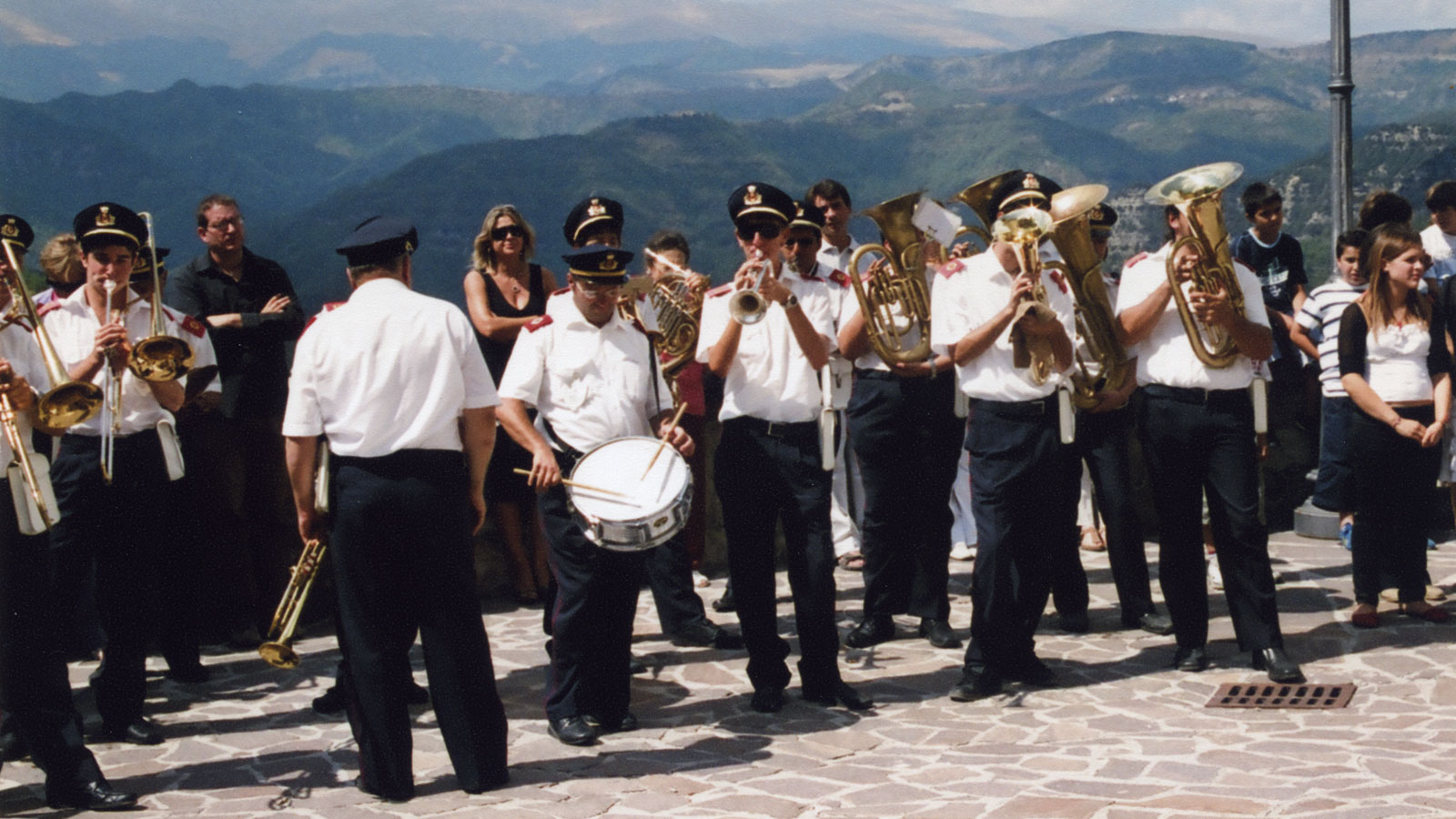
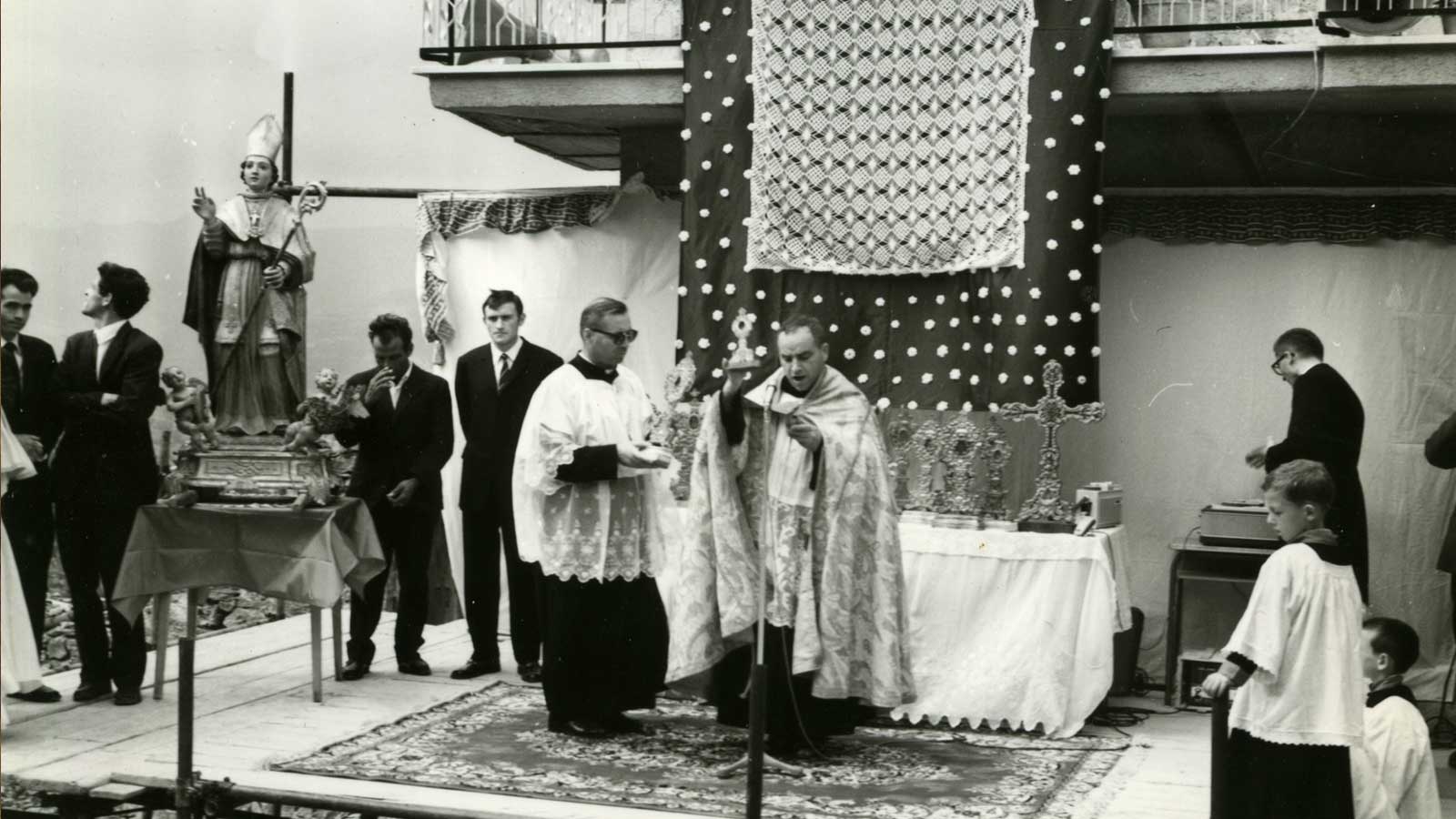
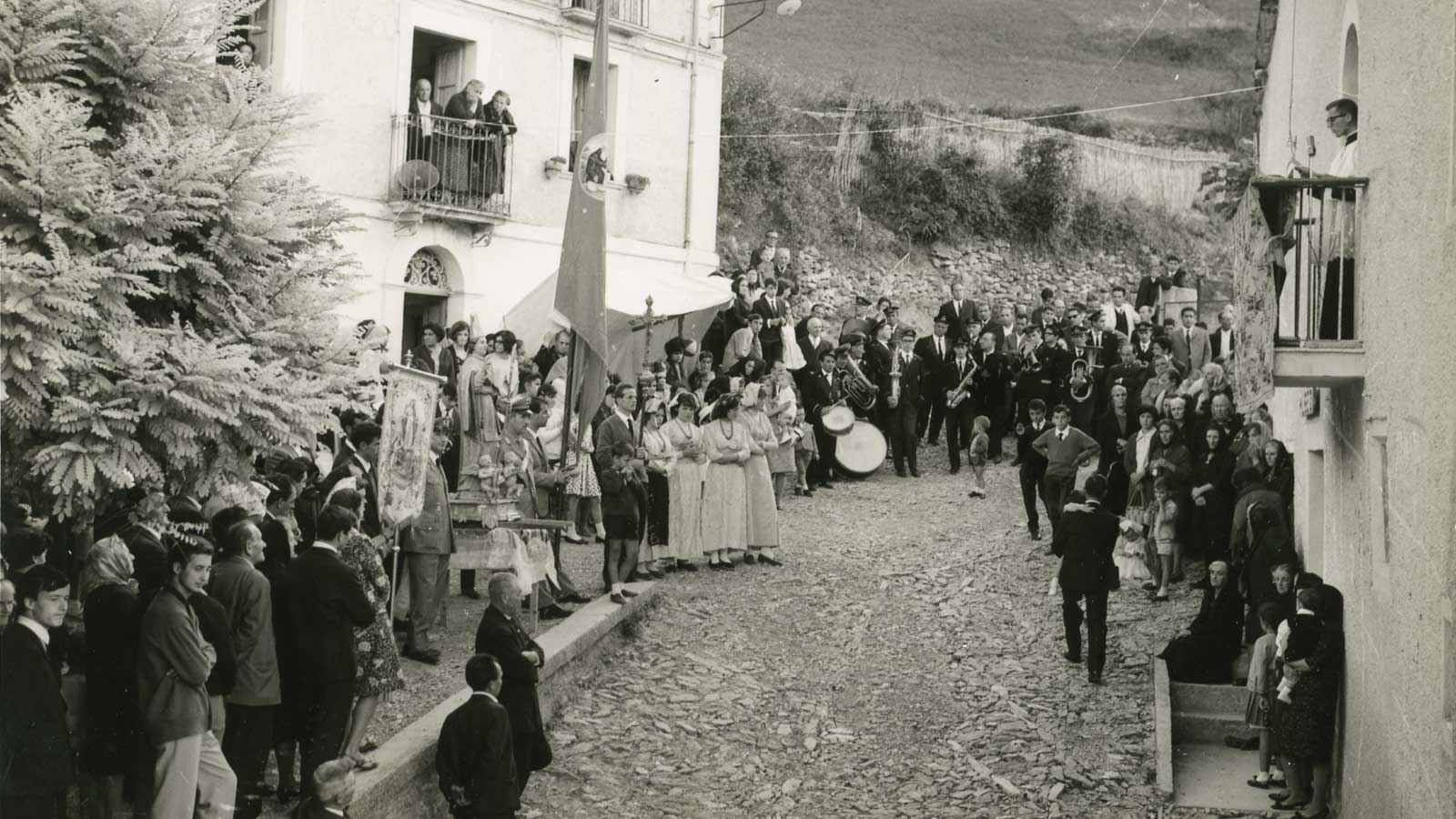
The day still begins with a solemn Mass, followed by a long, winding procession carrying the polychrome statue of Saint Giles the Abbot through the streets of the village and along the roads surrounding the settlement, before returning to the churchyard. It is here that the blessing with the relics takes place, the most distinctive rite of the entire feast. The ceremony consists of a rigorously timed and synchronised sequence of precise actions, repeated for each of the numerous relics, with those of the patron saint displayed at the end of the ritual exposition. The priest imparts the blessing in chant, answered by the amen of the faithful and followed by a brief performance by the band, the tolling of the bell in the bell tower and a volley of fireworks fired from the rocky ridge overlooking the village. Together, voices, musical instruments, bells and explosions orchestrate the entire festive soundscape. Over time, the location of the rite has changed—from the loggia at the rear of the church, to the balcony and the area in front of the parish house, and finally to the church square overlooking the valley and the mountains—but its ceremonial structure has been preserved and perpetuated. Since the mid-2000s, the original Latin formula has also been restored.
The history of Cerqueto in the second half of the twentieth century is inseparably linked to Don Nicola Jobbi, parish priest of the village from 1963 to 1984. A young priest from the countryside around Mosciano Sant’Angelo, Jobbi was a cultural organiser and “agitator” who set out to become “a Cerqueto man among the people of Cerqueto”, working to promote the village’s economic and social life while helping to safeguard the expressive elements of its local culture. He campaigned to provide Cerqueto with roads, running water and essential services, founded an ethnographic museum and launched numerous cultural initiatives. Above all, from the time of his arrival he began using a tape recorder to document the community’s songs, prayers and ceremonies, beginning with the Feast of Saint Giles and the blessing with the relics. It is thanks to this early awareness of their cultural value that we have the earliest known sound recording of the rite.
The Blessing with the Relics
Father Silvestro Misantoni, voice; band, bells, fireworks.
Cerqueto di Fano Adriano (TE), 1 September 1968.
Recording by Don Nicola Jobbi, Jobbi Collection, Don Nicola Jobbi Study Centre / Melchiorre Dèlfico Library.
Cerqueto di Fano Adriano (TE), 1 September 1968.
Recording by Don Nicola Jobbi, Jobbi Collection, Don Nicola Jobbi Study Centre / Melchiorre Dèlfico Library.
Listen to the track

From Relic to Relic
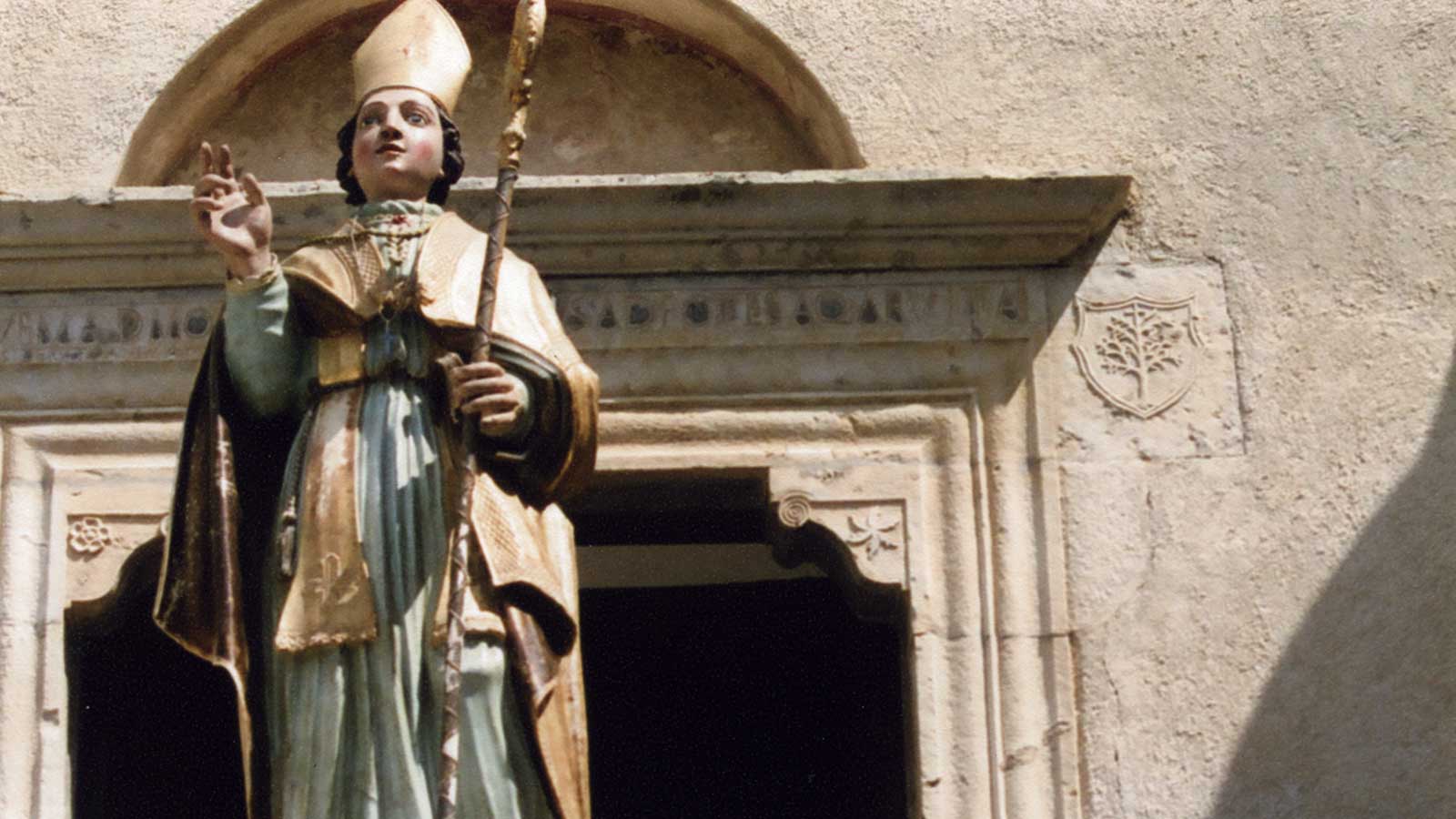
The Statue of Saint Giles
The polychrome wooden statue of Saint Giles, depicted as a mitred abbot holding a crosier and raising his hand in blessing, beside the portal of the parish church.
Photo by Gianfranco Spitilli,
Cerqueto di Fano Adriano (TE), 1 September 2007,
Don Nicola Jobbi Study Centre/Bambun Archive.
Photo by Gianfranco Spitilli,
Cerqueto di Fano Adriano (TE), 1 September 2007,
Don Nicola Jobbi Study Centre/Bambun Archive.
From Relic to Relic
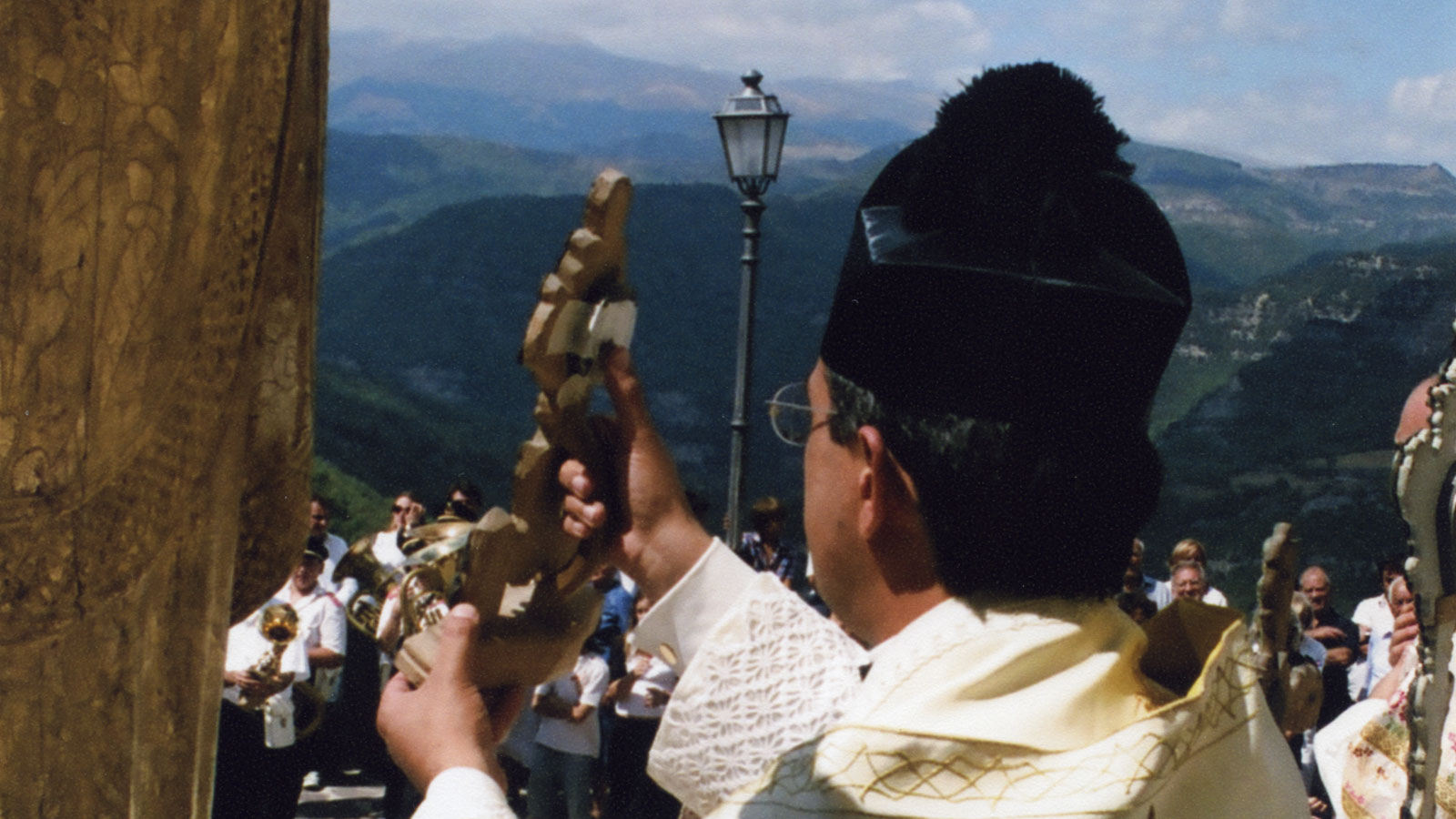
The Blessing
The priest, Don Filippo Lanci, imparts the blessing with the relics facing the crowd; below, the band musicians and the faithful can be seen. In the background, the mountains encircling the Vomano Valley.
Photo by Gianfranco Spitilli,
Cerqueto di Fano Adriano (TE), 1 September 2007,
Don Nicola Jobbi Study Centre/Bambun Archive.
Photo by Gianfranco Spitilli,
Cerqueto di Fano Adriano (TE), 1 September 2007,
Don Nicola Jobbi Study Centre/Bambun Archive.
From Relic to Relic
The Band
The band during the blessing, in the open space in front of the church overlooking the mountains: the instrumental performance is an integral part of the ritual’s sonic sequence.
Photo by Gianfranco Spitilli,
Cerqueto di Fano Adriano (TE), 1 September 2007,
Don Nicola Jobbi Study Centre/Bambun Archive.
Photo by Gianfranco Spitilli,
Cerqueto di Fano Adriano (TE), 1 September 2007,
Don Nicola Jobbi Study Centre/Bambun Archive.
From Relic to Relic
Don Nicola Jobbi at Work
Don Nicola Jobbi, on the right, records the blessing with the relics using a reel-to-reel tape recorder; Father Silvestro Misantoni is in the centre.
Photo by Federico Mastrodascio,
Cerqueto di Fano Adriano (TE), 1 September 1968,
Jobbi Collection,
Don Nicola Jobbi Study Centre / Melchiorre Dèlfico Library.
Photo by Federico Mastrodascio,
Cerqueto di Fano Adriano (TE), 1 September 1968,
Jobbi Collection,
Don Nicola Jobbi Study Centre / Melchiorre Dèlfico Library.
From Relic to Relic
The Blessing from the Balcony
D Don Nicola Jobbi imparts the blessing with the relics from the church balcony after the reading of the bull of Pope Eugene IV.
Cerqueto di Fano Adriano (TE), 1 September 1966,
Jobbi Collection,
Don Nicola Jobbi Study Centre / Melchiorre Dèlfico Library.
Cerqueto di Fano Adriano (TE), 1 September 1966,
Jobbi Collection,
Don Nicola Jobbi Study Centre / Melchiorre Dèlfico Library.
Watch the video
The Procession of Saint Giles
The footage shows part of the procession, beginning as the statue of the saint is carried out of the church.
Cerqueto di Fano Adriano (TE), 1 September 2011.
Footage by Stefano Saverioni and Gianluca Pisciaroli,
Don Nicola Jobbi Study Centre/Bambun Archive.
Cerqueto di Fano Adriano (TE), 1 September 2011.
Footage by Stefano Saverioni and Gianluca Pisciaroli,
Don Nicola Jobbi Study Centre/Bambun Archive.
Cultural transmission and protection
The people of Cerqueto have a deep attachment to their patron saint, as demonstrated by the repeated changes to the date of the feast. In 1971, Don Nicola Jobbi himself, seeking to accommodate emigrants who could more easily return to the village at weekends, decided to move the feast from 1 September to the last Sunday of August. The decision, intended to bring the community together, instead deeply divided it: the older inhabitants and the members of the feast committee regarded it as an affront, to the point that some travelled to the Sanctuary of Saint Gabriel to ascertain whether the indulgences associated with the papal bull of 1432 were also valid outside 1 September, only to receive a negative answer. After years of disagreement, the feast was restored to its canonical date of 1 September in the mid-2000s.
The Feast of Saint Giles is one of the best-documented celebrations in the Teramo mountain area. The recordings made by Don Nicola Jobbi, beginning in 1963, have been safeguarded, digitised and studied by the Bambun APS association and anthropologist Gianfranco Spitilli, also through the establishment of the Don Nicola Jobbi Study Centre. The collection is now held at the “Melchiorre Dèlfico” Regional Library in Teramo and has provided material for publications and exhibitions. It is also an integral part of the Abruzzo Digital Archive, where an extensive selection of its contents can be consulted. Over the years, the feast has also been photographed by numerous professionals and enthusiasts, including Japanese anthropologist Yutaka Tani and Japanese architect Satoshi Miyazawa, who came to Cerqueto to study, respectively, its pastoral society and traditional houses, as well as photographers such as Beppe Monti from Teramo. More recently, Gianfranco Spitilli has documented several editions of the feast through photography and sound recording whilst filmmaker Stefano Saverioni, in collaboration with Cerqueto photographer Gianluca Pisciaroli, documented it audiovisually for a RAI documentary. Pisciaroli himself and, subsequently, another photographer from Cerqueto, Francesco Fotia, have carried out extensive photographic documentation of the feast over the years. Finally, the restoration work on the sanctuary, initiated by Don Jobbi in the second half of the 1960s, has been fundamental to the continuation of the devotion and cult.
The Feast of Saint Giles is one of the best-documented celebrations in the Teramo mountain area. The recordings made by Don Nicola Jobbi, beginning in 1963, have been safeguarded, digitised and studied by the Bambun APS association and anthropologist Gianfranco Spitilli, also through the establishment of the Don Nicola Jobbi Study Centre. The collection is now held at the “Melchiorre Dèlfico” Regional Library in Teramo and has provided material for publications and exhibitions. It is also an integral part of the Abruzzo Digital Archive, where an extensive selection of its contents can be consulted. Over the years, the feast has also been photographed by numerous professionals and enthusiasts, including Japanese anthropologist Yutaka Tani and Japanese architect Satoshi Miyazawa, who came to Cerqueto to study, respectively, its pastoral society and traditional houses, as well as photographers such as Beppe Monti from Teramo. More recently, Gianfranco Spitilli has documented several editions of the feast through photography and sound recording whilst filmmaker Stefano Saverioni, in collaboration with Cerqueto photographer Gianluca Pisciaroli, documented it audiovisually for a RAI documentary. Pisciaroli himself and, subsequently, another photographer from Cerqueto, Francesco Fotia, have carried out extensive photographic documentation of the feast over the years. Finally, the restoration work on the sanctuary, initiated by Don Jobbi in the second half of the 1960s, has been fundamental to the continuation of the devotion and cult.
OTHER ASSETS IN THE SAME MUNICIPALITOTHER ASSETS IN THE SAME MUNICIPALITY

Crossed voices
Il canto a “vatocco” a Cerqueto

We, the pilgrims
The almsgiving of Saint Anthony the Abbot in Fano Adriano

In Celebration
Bells and bell ringers in Fano Adriano
The Shepherds’ Saint
The Feast of Saint Valentine in Fano Adriano