
Arts and endertainment
In Celebration
Bells and bell ringers in Fano Adriano
Consecrated bronze bells suspended in the tower of the Church of Saints Peter and Paul, the bells of Fano Adriano have marked the rhythm of community life for centuries: prayer and work, celebration and mourning, alarm and summons. Rung by hand, either from below by pulling the ropes or from the bell tower itself by handling ropes and clappers, they weave together their powerful voices through the skill of a devoted group of bell ringers who have inherited both the performance techniques and the traditional ringing patterns. During the feast of Saint Valentine, the patron saint, the bells ring ad allegrezza (“in celebration”), when the square fills with people, and the village rediscovers its “voice of God”.
“The ad allegrezza ringing was performed to announce the major feast days: the Patron Saint, Corpus Christi, the Assumption and the Immaculate Conception. Today, in Fano, this way of announcing a celebration has survived only for the feast of Saint Valentine, the patron saint.”
Nello de Arcangelis, 1998
A bell is a struck idiophone, generally cast in bronze, whose sound is produced by the impact of a metal pendulum, known as the clapper, against the inner wall of the instrument. As the community sound par excellence, the ringing of bells has, throughout Christian Europe, encoded for centuries a true language at a distance, capable either of calling people together (a centripetal function) or of warning, dispersing and signalling (a centrifugal function): announcing religious services, marking the hours of the day, warning of danger and proclaiming deaths. For the peasants of central Italy, bells were the “voice of God”. At the same time, the sound of consecrated bronze was long believed to possess protective and apotropaic powers against lightning, hailstorms and other natural calamities.
In Fano Adriano, on the Teramo side of Gran Sasso, the parish church of Saints Peter and Paul houses in its bell tower, dating from 1658, a peal of four bells: the grossa (great bell), the mezzana (middle bell), the campana che accenna (“leading bell”), and the campana a tocchetti (“small-timekeeping bell”), differing in size and weight and tuned together in G major. The oldest, the grossa, was recast in 1760 and, according to tradition, cast in the village itself in a pit dug in Piazza Prato. The other bells were recast between 1935 and 1994, while today the maintenance of the mechanisms is entrusted to bell founders from Molise.
The “language” of the bells of Fano Adriano is rich and highly codified. Four principal ringing techniques — a tocco, a martello, a distesa and a fuoco — give rise to a wide repertoire of ringing patterns, each carrying a precise meaning. A morto (the funeral ringing) is performed from below, by measured tolls, and concludes with the great bell alone: two tolls indicate the death of a woman, three that of a man, ensuring that the entire village is informed of the bereavement. A fuoco (“fire ringing”) was performed by making the clapper rotate against the inner wall of the bell to signal the outbreak of a fire. In the past, the bells also structured the rhythm of everyday life: the Mattutino at dawn, “varying the hour from season to season”; the Angelus at midday, announcing the time to pause from work; the Ventunora, three hours before dusk, recalling those scattered across the mountains in their daily activities; and the first and second Ave Maria, inviting the community to silence after sunset.
Many of these signals reflect the village’s dual identity, at once settled and transhumant. Until the first half of the twentieth century, Fano Adriano was a community of livestock owners, shepherds and high-altitude farmers, and many of its men spent the autumn and winter months with their flocks in the Roman Campagna and in Apulia. For this reason, the feast of the patron saint on 14 February, deeply felt by the community, was effectively celebrated again at the beginning of September, before the departure of the transhumant shepherds. This custom survives today in the celebration of two annual feast days, the second held on the last Sunday of August and invariably accompanied by festive bell ringing. The climax of the celebration is the ad allegrezza ringing, once reserved for the greatest solemnities and today preserved specifically for the feast of Saint Valentine. Described with remarkable precision by Nello de Arcangelis in his study The Language of Bells from the Fourth to the Nineteenth Century, it is a ringing pattern requiring the cooperation of several performers in the bell tower and perfect synchronisation, acquired through experience and by observing older bell ringers at work. It begins with a trembling movement of the clappers against the inner walls of the bells, followed by a succession of precisely timed blows a martello (or a carillon), repeated five or six times under the direction of the bell ringer of the great bell. It then moves into the second phase, known as alla fratina, during which the great bell is rung a distesa — in dialect abbendà, “to launch” the bell — while the other three keep the rhythm. Coordinating bells of different weights, while synchronising with the clapper of the great bell as it swings back and forth, is physically demanding. During the a distesa phase in particular, the bell ringers often relieve one another in turn, striving not to lose the rhythm established for the performance.
Alongside the festive peal, there also survives, as its ritual counterpart, the custom of “tying” the bells during Holy Week, from the Gloria of Holy Thursday until the Easter Vigil. In the past, the bells were replaced by the tric trac, a wooden-and-metal direct-struck idiophone operated by the village boys as they walked through the streets. “If the bells were not tied,” de Arcangelis explains, “they would ring by themselves, foretelling misfortune because of Christ’s death.”
In Fano Adriano, on the Teramo side of Gran Sasso, the parish church of Saints Peter and Paul houses in its bell tower, dating from 1658, a peal of four bells: the grossa (great bell), the mezzana (middle bell), the campana che accenna (“leading bell”), and the campana a tocchetti (“small-timekeeping bell”), differing in size and weight and tuned together in G major. The oldest, the grossa, was recast in 1760 and, according to tradition, cast in the village itself in a pit dug in Piazza Prato. The other bells were recast between 1935 and 1994, while today the maintenance of the mechanisms is entrusted to bell founders from Molise.
The “language” of the bells of Fano Adriano is rich and highly codified. Four principal ringing techniques — a tocco, a martello, a distesa and a fuoco — give rise to a wide repertoire of ringing patterns, each carrying a precise meaning. A morto (the funeral ringing) is performed from below, by measured tolls, and concludes with the great bell alone: two tolls indicate the death of a woman, three that of a man, ensuring that the entire village is informed of the bereavement. A fuoco (“fire ringing”) was performed by making the clapper rotate against the inner wall of the bell to signal the outbreak of a fire. In the past, the bells also structured the rhythm of everyday life: the Mattutino at dawn, “varying the hour from season to season”; the Angelus at midday, announcing the time to pause from work; the Ventunora, three hours before dusk, recalling those scattered across the mountains in their daily activities; and the first and second Ave Maria, inviting the community to silence after sunset.
Many of these signals reflect the village’s dual identity, at once settled and transhumant. Until the first half of the twentieth century, Fano Adriano was a community of livestock owners, shepherds and high-altitude farmers, and many of its men spent the autumn and winter months with their flocks in the Roman Campagna and in Apulia. For this reason, the feast of the patron saint on 14 February, deeply felt by the community, was effectively celebrated again at the beginning of September, before the departure of the transhumant shepherds. This custom survives today in the celebration of two annual feast days, the second held on the last Sunday of August and invariably accompanied by festive bell ringing. The climax of the celebration is the ad allegrezza ringing, once reserved for the greatest solemnities and today preserved specifically for the feast of Saint Valentine. Described with remarkable precision by Nello de Arcangelis in his study The Language of Bells from the Fourth to the Nineteenth Century, it is a ringing pattern requiring the cooperation of several performers in the bell tower and perfect synchronisation, acquired through experience and by observing older bell ringers at work. It begins with a trembling movement of the clappers against the inner walls of the bells, followed by a succession of precisely timed blows a martello (or a carillon), repeated five or six times under the direction of the bell ringer of the great bell. It then moves into the second phase, known as alla fratina, during which the great bell is rung a distesa — in dialect abbendà, “to launch” the bell — while the other three keep the rhythm. Coordinating bells of different weights, while synchronising with the clapper of the great bell as it swings back and forth, is physically demanding. During the a distesa phase in particular, the bell ringers often relieve one another in turn, striving not to lose the rhythm established for the performance.
Alongside the festive peal, there also survives, as its ritual counterpart, the custom of “tying” the bells during Holy Week, from the Gloria of Holy Thursday until the Easter Vigil. In the past, the bells were replaced by the tric trac, a wooden-and-metal direct-struck idiophone operated by the village boys as they walked through the streets. “If the bells were not tied,” de Arcangelis explains, “they would ring by themselves, foretelling misfortune because of Christ’s death.”
Occasions and techniques
Germano Franciosi, voice.
Fano Adriano (TE), 18 December 2012.
Recording by Gianfranco Spitilli,
Don Nicola Jobbi/Bambun Study Centre Archive.
Fano Adriano (TE), 18 December 2012.
Recording by Gianfranco Spitilli,
Don Nicola Jobbi/Bambun Study Centre Archive.
Listen to the track


In Celebration
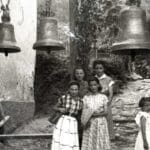
The bells brought down from the tower.
The bells being lowered from the tower for the recasting of the cracked mezzana (middle bell) and the replacement of the wooden pins supporting the beams with iron pins and their corresponding bearings. Beneath the bells stand Angelina Franciosi and the sisters Teresa and Alba Pavone.
Photo by Silvino Franciosi,
Fano Adriano (TE), 1953,
Franciosi Family Archive and Don Nicola Jobbi/Bambun Study Centre Archive.
Photo by Silvino Franciosi,
Fano Adriano (TE), 1953,
Franciosi Family Archive and Don Nicola Jobbi/Bambun Study Centre Archive.

In Celebration
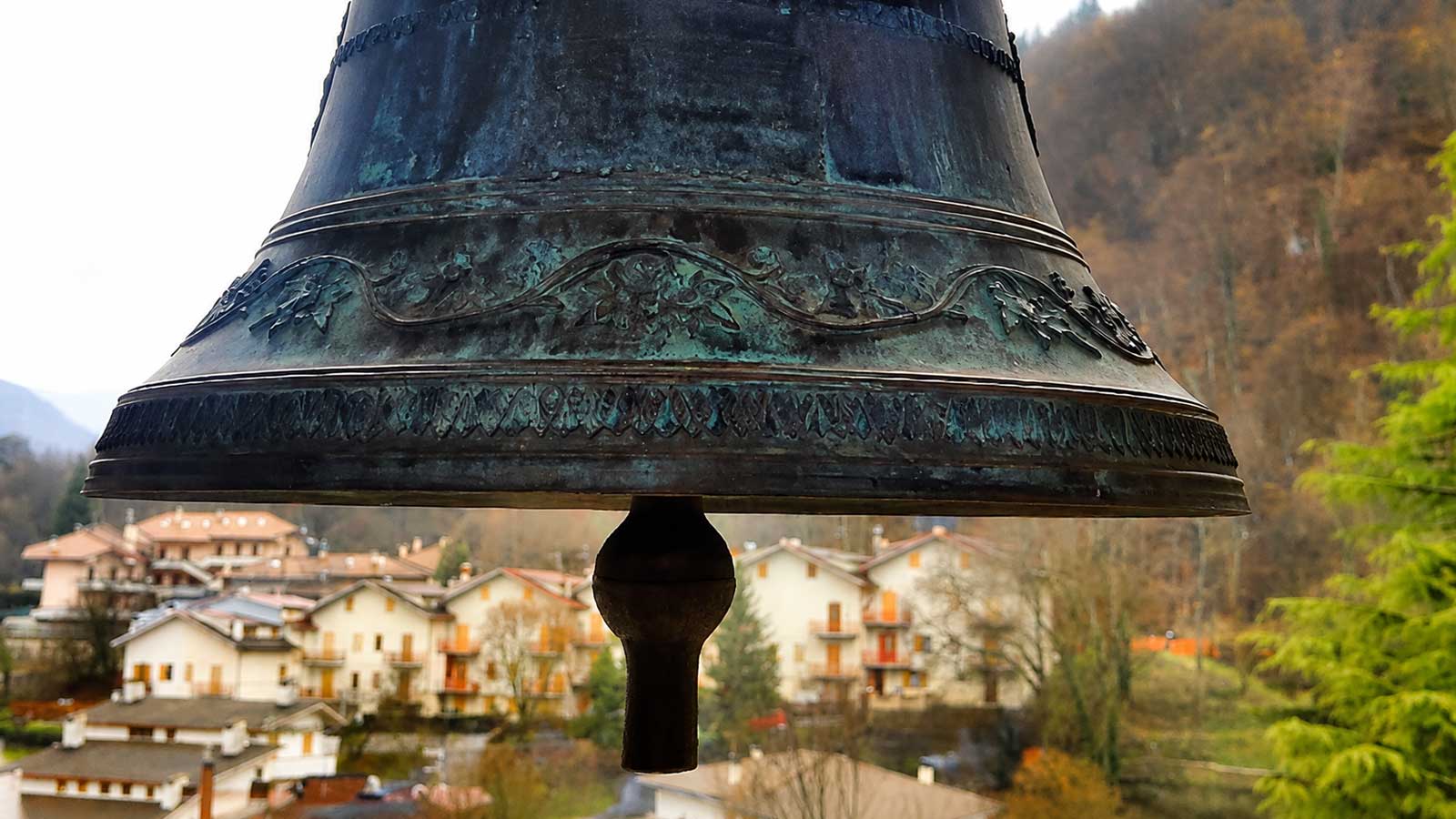
The campana che accenna
Detail of the campana che accenna (“leading bell”), decorated with a relief frieze, with a view of the village below.
Photo by Emanuele Di Paolo,
Fano Adriano (TE), 14 February 2026,
Don Nicola Jobbi/Bambun Study Centre Archive.
Photo by Emanuele Di Paolo,
Fano Adriano (TE), 14 February 2026,
Don Nicola Jobbi/Bambun Study Centre Archive.

In Celebration
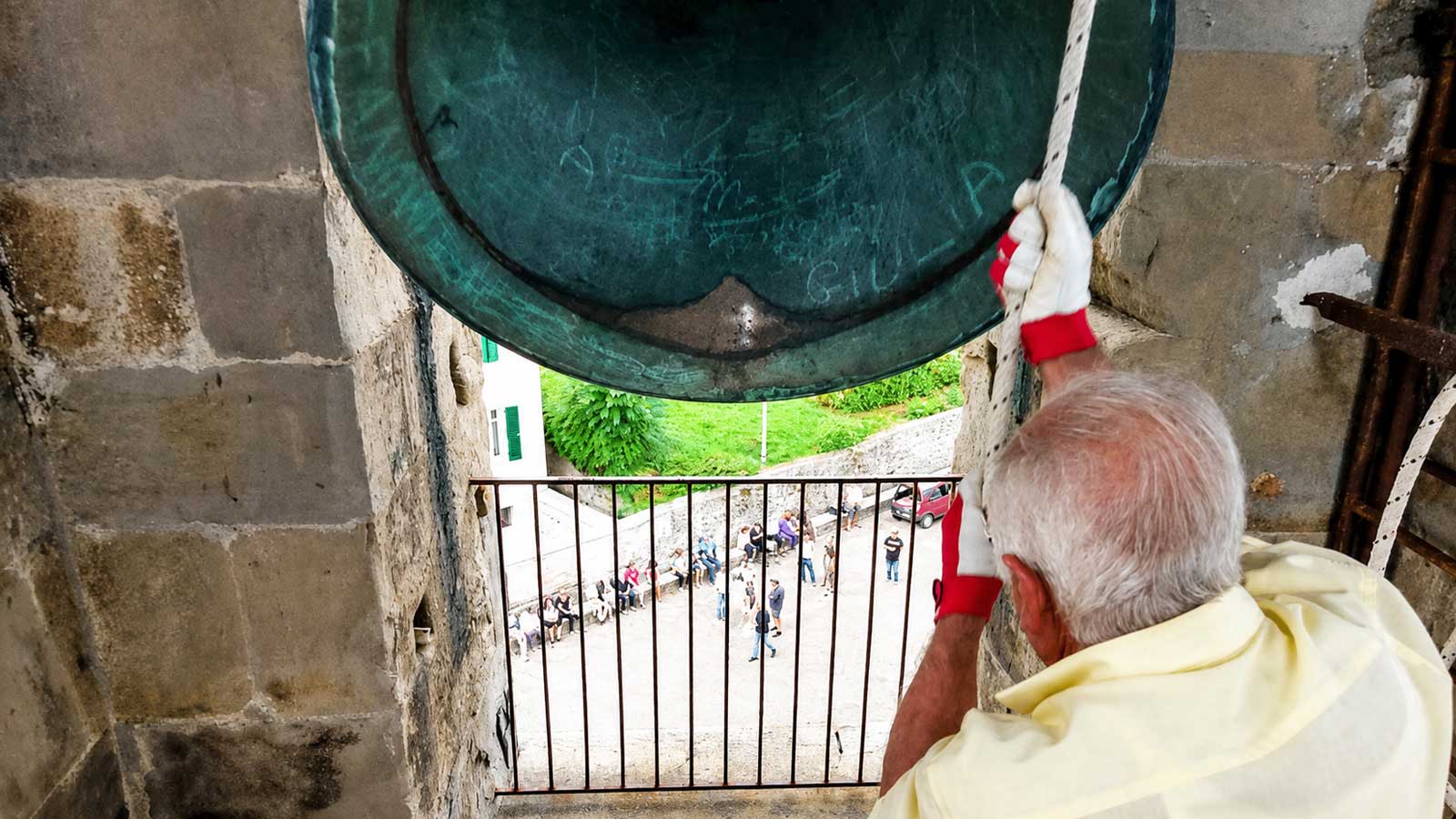
At the great bell
Luigi Luciani, known as “Bosco”, ringing the grossa (great bell) during the summer feast of Saint Valentine; below, in the square, the gathered community listens.
Photo by Carlo Di Bonaventura,
Fano Adriano (TE), 26 August 2018,
I Grignetti Association Archive.
Photo by Carlo Di Bonaventura,
Fano Adriano (TE), 26 August 2018,
I Grignetti Association Archive.

In Celebration
Bell ringers in action
Two bell ringers in action in the bell tower of the Church of Saints Peter and Paul during the feast of Saint Valentine. In the foreground, Battista Luciani rings the grossa a distesa; in the background, Giovanni Franco performs on the mezzana.
Photo by Luigi Guerrieri,
Fano Adriano (TE), 25 August 2019,
Guerrieri Archive.
Photo by Luigi Guerrieri,
Fano Adriano (TE), 25 August 2019,
Guerrieri Archive.
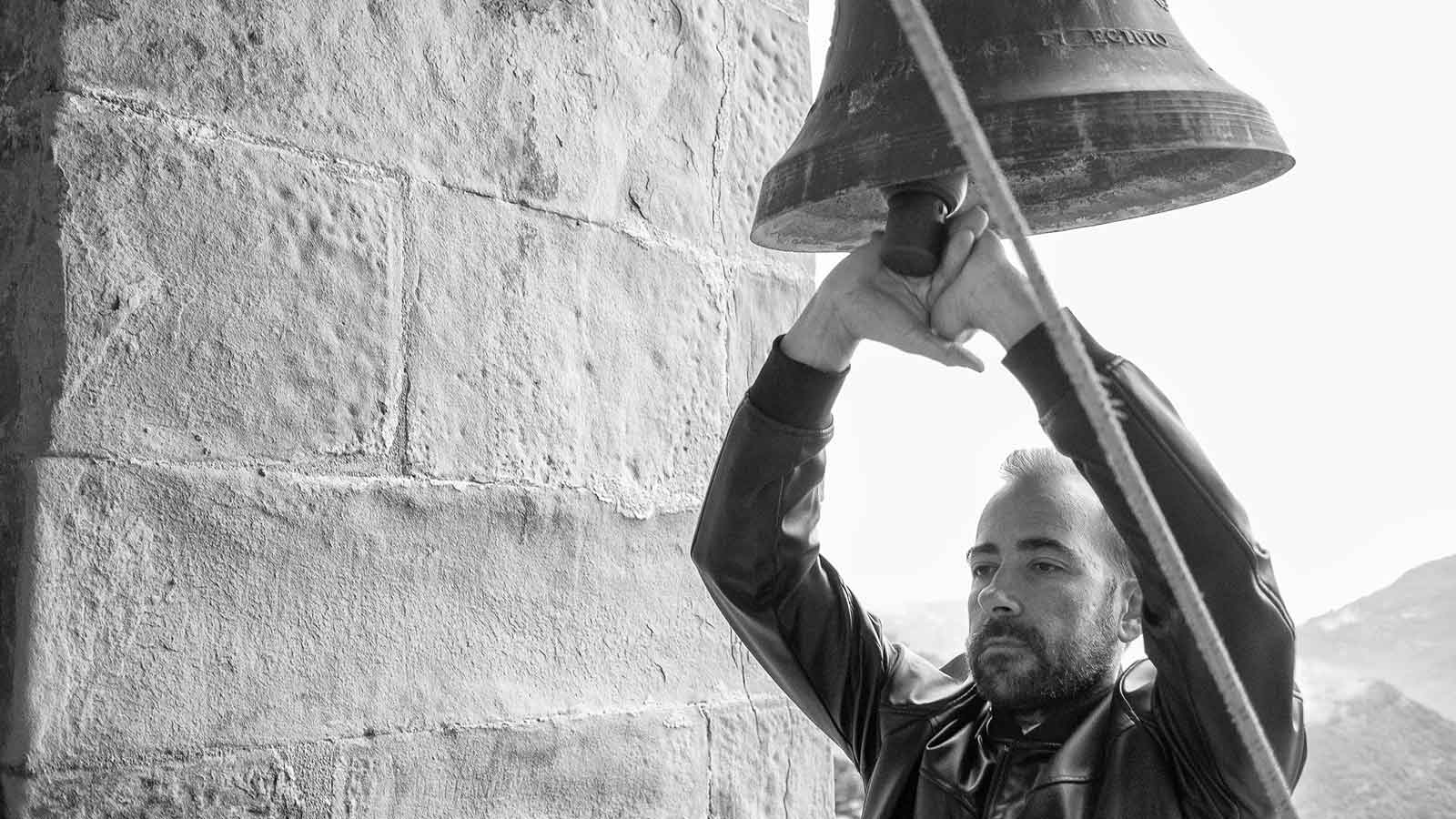

In Celebration
At the small bell
The bell ringer Paolo Riccioni performing a martello on the small bell, holding the clapper by hand.
Photo by Luigi Guerrieri,
Fano Adriano (TE), 25 August 2019,
Guerrieri Archive.
Photo by Luigi Guerrieri,
Fano Adriano (TE), 25 August 2019,
Guerrieri Archive.
Watch the video
The Saint Valentine bell ringing.
The bell ringing for the feast of Saint Valentine: from the tolling performed from below the bell tower using the long ropes to some of the phases performed from the top of the tower, where the bell ringers Giovanni Franco, Franco Di Pietro, Leonardo Rizzotti and Carlo Di Bonaventura take turns performing a martello and the physically demanding a distesa, culminating in the ad allegrezza phase, during which the strokes of the launched grossa (great bell) are synchronised with the rhythm manually beaten by the clappers of the other three bells.
Fano Adriano (TE), 14 February 2026.
Footage by Emanuele Di Paolo,
Don Nicola Jobbi/Bambun Study Centre Archive.
Fano Adriano (TE), 14 February 2026.
Footage by Emanuele Di Paolo,
Don Nicola Jobbi/Bambun Study Centre Archive.
Cultural transmission and protection
In Fano Adriano, the art of bell ringing has historically been a male skill, acquired through direct transmission by climbing the bell tower from childhood alongside more experienced bell ringers. “It is an art that is learned and handed down,” the elderly bell ringer Germano Franciosi used to say, “not from father to son, but from an older citizen to a younger one.” It is refined and mastered through practice, imitation, listening and careful observation of the bell ringers’ movements, of the internal dynamics of the ringing patterns, of the motion of the great bell’s clapper, of the bell “launched” a distesa, and of the distinctive synchronisation among the four bells of the tower. Besides Germano Franciosi himself, important figures in this tradition included the photographer and bell ringer Silvino Franciosi—long the only person capable of performing a tocco on the great bell—together with earlier bell ringers remembered by Nello de Arcangelis, such as “Valentino di Angeletta”, “Leone”, “Occhietto” and “Peppuccio”, among the many who succeeded one another over the decades. Today, the leading custodians of the performing tradition of the bell ringing patterns are Luigi Luciani, known as “Bosco”, and Franco Di Pietro, regarded as the most experienced and accomplished bell ringers, followed by a group of performers of different ages, including the youngest generations.
In terms of official recognition, the traditional art of bell ringing (Manual bell ringing) was inscribed on UNESCO’s Representative List of the Intangible Cultural Heritage of Humanity: first in 2022, following the initiative of Spain, and, from December 2024 onwards, with the extension of the inscription to Italy, where the safeguarding and transmission of this art—which encompasses both tangible elements, such as bells, bell chambers and supporting frameworks, and intangible elements, such as techniques, gestures and the knowledge of bell ringers—are promoted by the Italian National Federation of Bell Ringers, which coordinated the Italian candidature. Within this framework, the practice of Fano Adriano represents a local expression of a tradition now recognised as part of the cultural heritage of humanity, to which the community remains deeply attached. Compared with other villages in the area, transmission appears relatively more vital: in recent years several young people, including some girls, have approached the art of bell ringing and begun to perform it. Nevertheless, its use is now largely confined to the two annual celebrations of Saint Valentine—the feast on 14 February and its repetition at the end of August—while many of the functional ringing patterns of the past, such as the Ventunora, the Mattutino and the a fuoco ringing, have fallen into disuse.
The documentation of the bell ringing carried out in recent years in Fano Adriano by the musician Francesco Duranti, together with the extensive photographic survey produced, among others, by Luigi Guerrieri, and the documentation created locally by the bell ringers themselves and by the village associations, bears witness to the vitality of the practice and provides valuable material for future safeguarding initiatives. Of particular importance in this respect is the study written by Nello de Arcangelis in 1998, The Language of Bells from the Fourth to the Nineteenth Century, which offers a comprehensive examination of every aspect of bell ringing in Fano Adriano.
In terms of official recognition, the traditional art of bell ringing (Manual bell ringing) was inscribed on UNESCO’s Representative List of the Intangible Cultural Heritage of Humanity: first in 2022, following the initiative of Spain, and, from December 2024 onwards, with the extension of the inscription to Italy, where the safeguarding and transmission of this art—which encompasses both tangible elements, such as bells, bell chambers and supporting frameworks, and intangible elements, such as techniques, gestures and the knowledge of bell ringers—are promoted by the Italian National Federation of Bell Ringers, which coordinated the Italian candidature. Within this framework, the practice of Fano Adriano represents a local expression of a tradition now recognised as part of the cultural heritage of humanity, to which the community remains deeply attached. Compared with other villages in the area, transmission appears relatively more vital: in recent years several young people, including some girls, have approached the art of bell ringing and begun to perform it. Nevertheless, its use is now largely confined to the two annual celebrations of Saint Valentine—the feast on 14 February and its repetition at the end of August—while many of the functional ringing patterns of the past, such as the Ventunora, the Mattutino and the a fuoco ringing, have fallen into disuse.
The documentation of the bell ringing carried out in recent years in Fano Adriano by the musician Francesco Duranti, together with the extensive photographic survey produced, among others, by Luigi Guerrieri, and the documentation created locally by the bell ringers themselves and by the village associations, bears witness to the vitality of the practice and provides valuable material for future safeguarding initiatives. Of particular importance in this respect is the study written by Nello de Arcangelis in 1998, The Language of Bells from the Fourth to the Nineteenth Century, which offers a comprehensive examination of every aspect of bell ringing in Fano Adriano.
OTHER ASSETS IN THE SAME MUNICIPALITOTHER ASSETS IN THE SAME MUNICIPALITY

Crossed voices
Il canto a “vatocco” a Cerqueto

We, the pilgrims
The almsgiving of Saint Anthony the Abbot in Fano Adriano