
Arts and endertainment
From Death to Life
The Passion of Christ in Ornano Grande
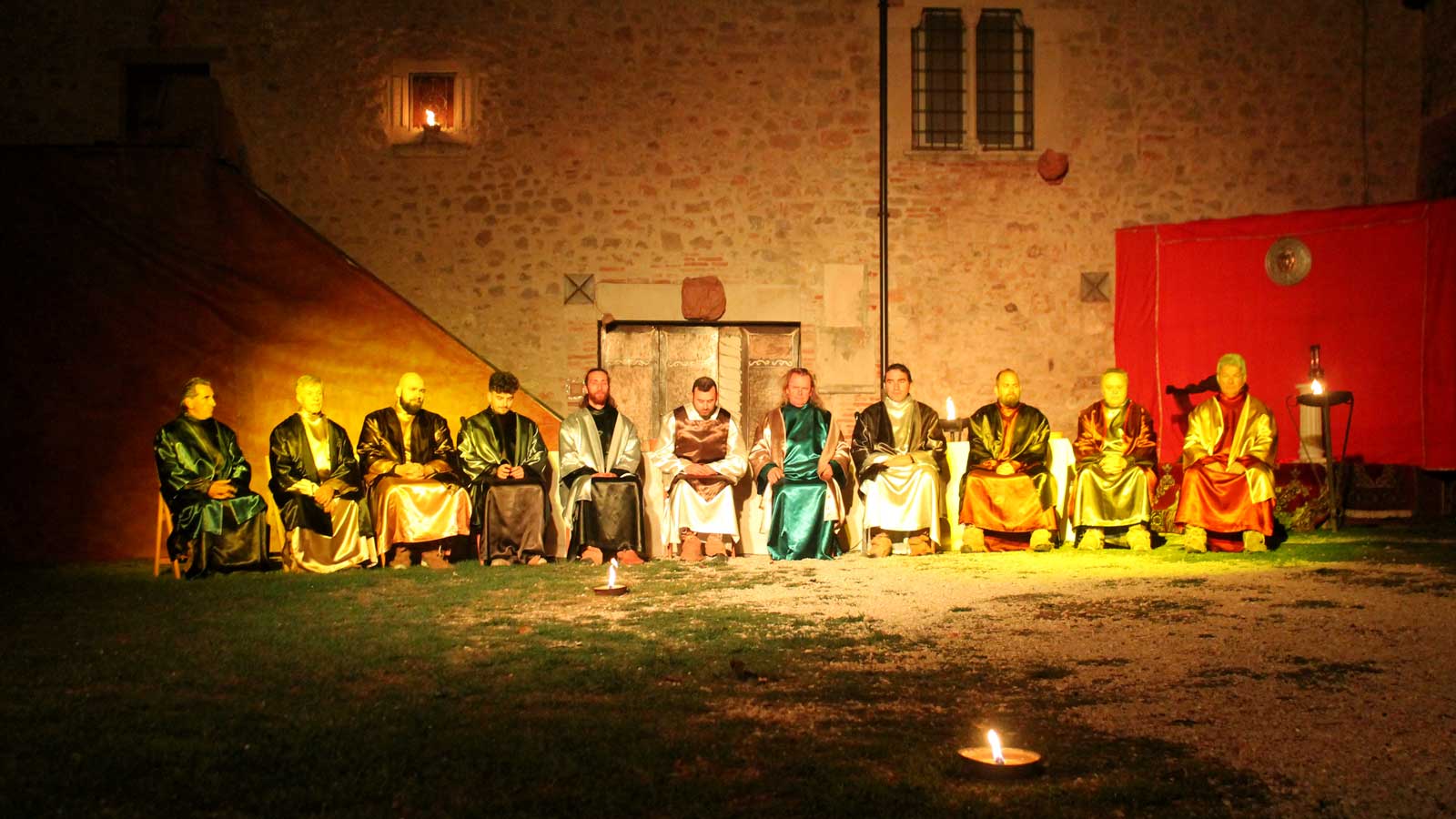
As evening falls, in the evocative light of torches and coloured spotlights, Ornano Grande is transformed into Jerusalem. Against the stone walls, the Apostles sit solemnly before the washing of the feet; beneath a colonnade, the High Priests wait; Roman soldiers in armour escort Christ, placing a crown of thorns upon his head. It is the entire community, gathered in the days preceding Holy Week, that accompanies Jesus’s journey through the Passion up to the moment of the Resurrection.
“The rule is that everything that happens this evening is everything that happens from tomorrow evening — Holy Monday — until Resurrection Sunday. We started with four scenes, then little by little we reconstructed everything that takes place during Holy Week.”
Giovanni De Dominicis, 29 March 2026
The Passion of Christ in Ornano Grande is a living sacred representation, an open-air popular theatre dedicated to the collective narration of the final days in the life of the Messiah, founder of Christianity. The scenes closely follow the Gospel accounts of the Passion and unfold by narrating the events that take place during Holy Week, from Holy Monday to Resurrection Sunday: Jesus’s entry into Jerusalem, the Last Supper, the washing of the feet, the agony in the Garden of Olives, the arrest, the trial before the High Priest, the scourging and condemnation, the crucifixion and, finally, the Resurrection, witnessed through the empty tomb illuminated by divine light. The overall structure of the present-day representation is the result of work developed over time, beginning with only a few limited scenes, to which new episodes were gradually added year after year, together with costumes, lighting and stage settings.
The true protagonist of the representation is the community. The costumes, rich and elaborate, have largely been made by the women of the village, who selected the fabrics and sewed the garments, continuously adapting them according to staging needs and the frequent rotation of performers. Roles are transmitted and exchanged over the years: some have played the Virgin Mary since the earliest editions; others have moved from one character to another until taking on the role of the Apostle John; others embody Christ by identifying with the final phase of his earthly journey. Behind the scenes, the parish priest Don Raffaele Mazzarelli rewove the social bonds loosened by earthquakes and other recent events, leaving the stage to the direct protagonists. At the same time, Giovanni De Dominicis — among the founders of the representation and a leading figure of the Passio Cristi committee — has overseen its direction since its origins. It is a collective work, “something for the village and for ourselves”, involving almost fifty people every year.
From an ethnographic perspective, the Passion of Ornano Grande forms part of a broad constellation of living Passion representations that includes important and historically established examples in Italy, such as the Passion of Cerveno in Valcamonica, performed every ten years, that of Sordevolo in Piedmont, and the Passion of Christ of Sezze in Lazio, to mention only some of the most significant and long-standing cases. These events involve entire communities and have experienced renewed diffusion over recent decades, to the point of forming networks dedicated to their safeguarding. The Passion of Ornano Grande belongs to this season of rediscovery, intertwining religious, civic and identity dimensions and becoming a moment of strong spiritual, cultural and performative significance for the entire parish community, rooted in the complex and long-standing devotional history of the village.
The true protagonist of the representation is the community. The costumes, rich and elaborate, have largely been made by the women of the village, who selected the fabrics and sewed the garments, continuously adapting them according to staging needs and the frequent rotation of performers. Roles are transmitted and exchanged over the years: some have played the Virgin Mary since the earliest editions; others have moved from one character to another until taking on the role of the Apostle John; others embody Christ by identifying with the final phase of his earthly journey. Behind the scenes, the parish priest Don Raffaele Mazzarelli rewove the social bonds loosened by earthquakes and other recent events, leaving the stage to the direct protagonists. At the same time, Giovanni De Dominicis — among the founders of the representation and a leading figure of the Passio Cristi committee — has overseen its direction since its origins. It is a collective work, “something for the village and for ourselves”, involving almost fifty people every year.
From an ethnographic perspective, the Passion of Ornano Grande forms part of a broad constellation of living Passion representations that includes important and historically established examples in Italy, such as the Passion of Cerveno in Valcamonica, performed every ten years, that of Sordevolo in Piedmont, and the Passion of Christ of Sezze in Lazio, to mention only some of the most significant and long-standing cases. These events involve entire communities and have experienced renewed diffusion over recent decades, to the point of forming networks dedicated to their safeguarding. The Passion of Ornano Grande belongs to this season of rediscovery, intertwining religious, civic and identity dimensions and becoming a moment of strong spiritual, cultural and performative significance for the entire parish community, rooted in the complex and long-standing devotional history of the village.
In the Garden of Olives
Performers of the Passion, voices; narrator’s voice; music and stage sounds.
Ornano Grande, Colledara (TE), 29 March 2026.
Recording by Emanuele Di Paolo,
Don Nicola Jobbi/Bambun Study Centre Archive.
Ornano Grande, Colledara (TE), 29 March 2026.
Recording by Emanuele Di Paolo,
Don Nicola Jobbi/Bambun Study Centre Archive.
Listen to the track

From Death to Life
The Apostles
The Apostles, wrapped in vividly coloured cloaks, wait seated against the stone wall in the scene preceding the washing of the feet.
Photo by Emanuele Di Paolo,
Ornano Grande, Colledara (TE), 29 March 2026,
Don Nicola Jobbi/Bambun Study Centre Archive.
Photo by Emanuele Di Paolo,
Ornano Grande, Colledara (TE), 29 March 2026,
Don Nicola Jobbi/Bambun Study Centre Archive.
From Death to Life
Jesus and the High Priest
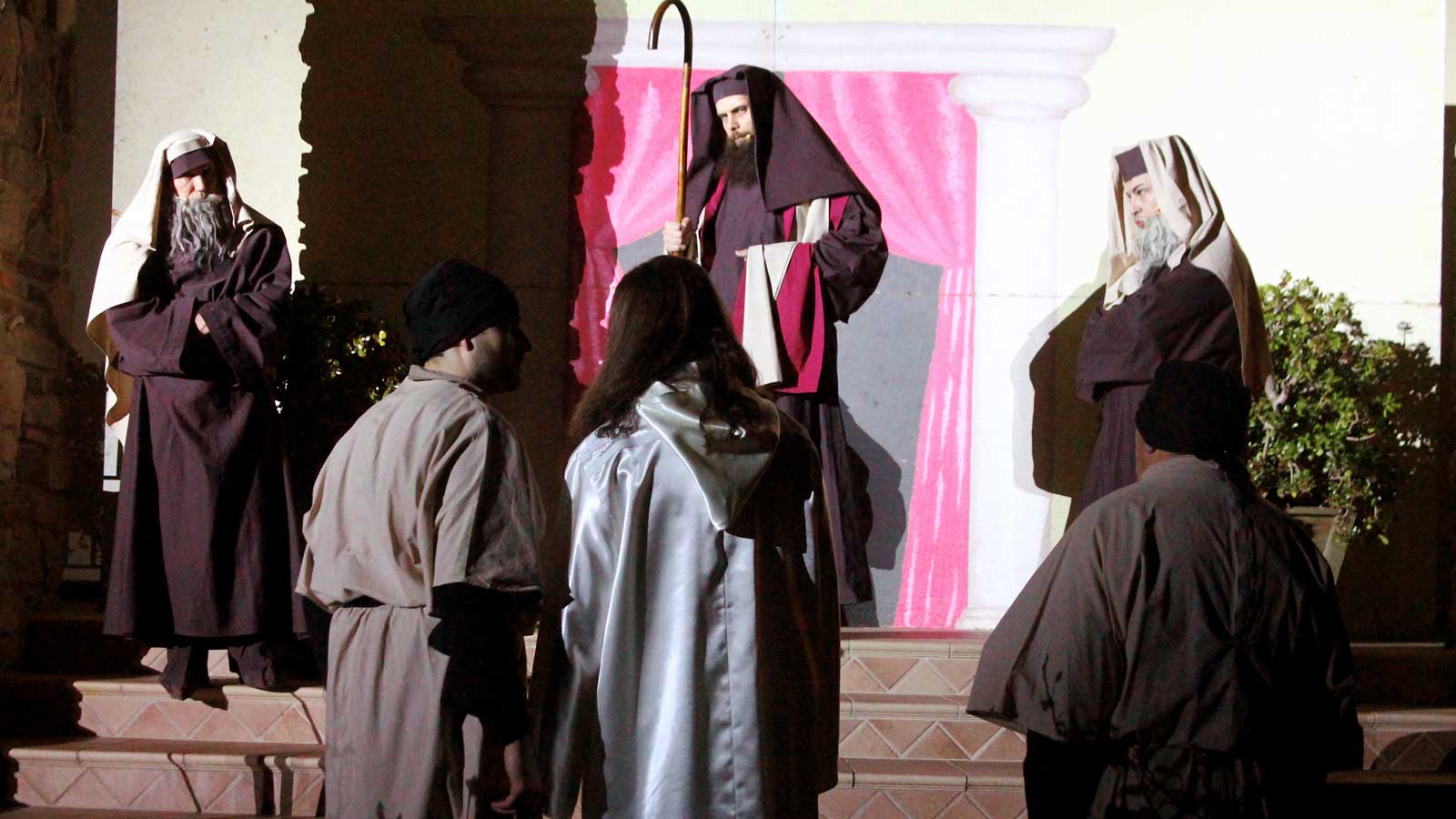
After the arrest, Jesus is brought before the High Priest beneath the colonnade of the temple, traced out on the stage.
Photo by Emanuele Di Paolo,
Ornano Grande, Colledara (TE), 29 March 2026,
Don Nicola Jobbi/Bambun Study Centre Archive.
Photo by Emanuele Di Paolo,
Ornano Grande, Colledara (TE), 29 March 2026,
Don Nicola Jobbi/Bambun Study Centre Archive.
From Death to Life
The condemnation
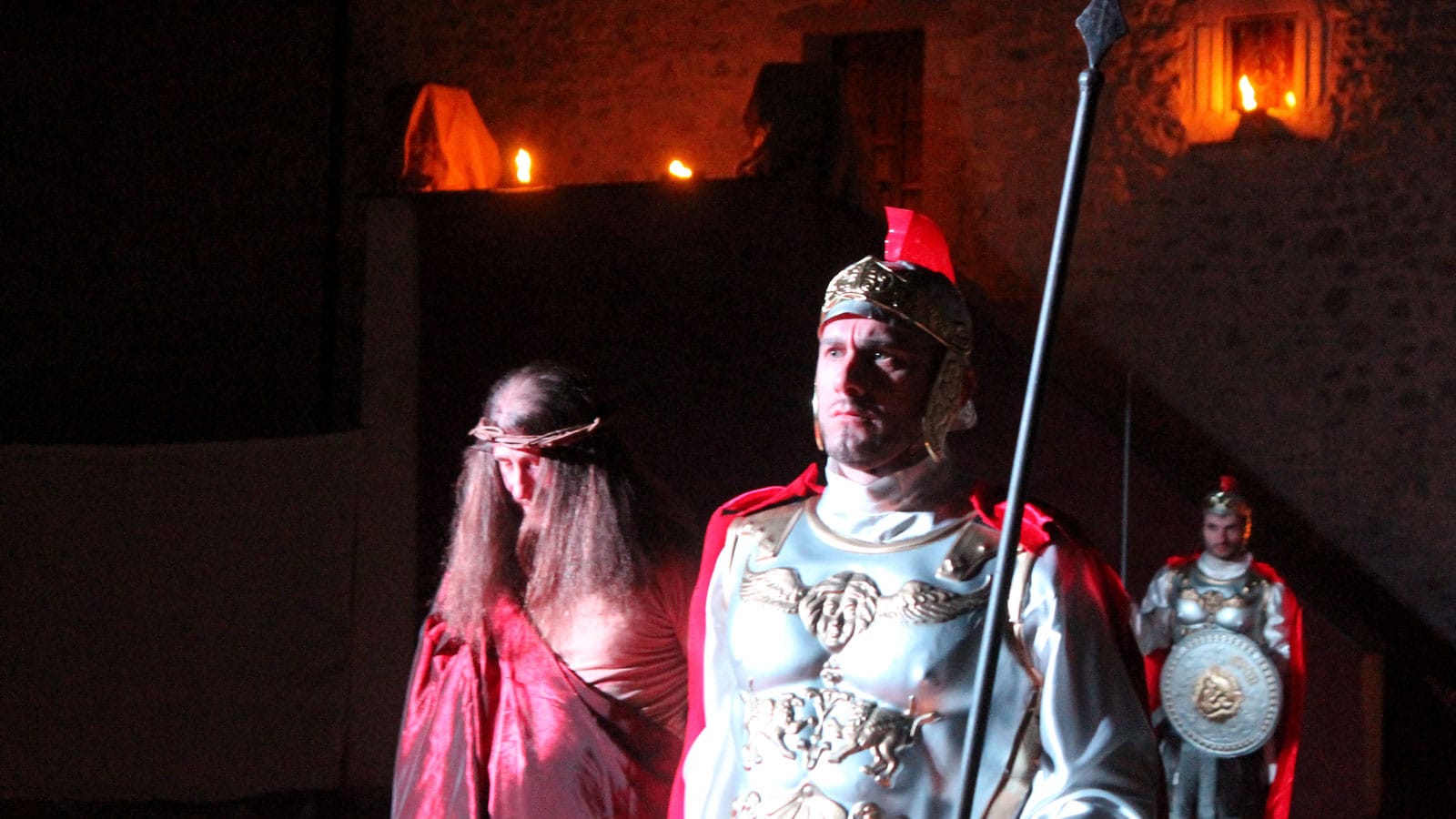
The condemnation following the scourging: in the foreground, a Roman soldier in armour and red cloak; behind him, Christ wearing the crown of thorns.
Photo by Emanuele Di Paolo,
Ornano Grande, Colledara (TE), 29 March 2026,
Don Nicola Jobbi/Bambun Study Centre Archive.
Photo by Emanuele Di Paolo,
Ornano Grande, Colledara (TE), 29 March 2026,
Don Nicola Jobbi/Bambun Study Centre Archive.
From Death to Life
The Crucifixion
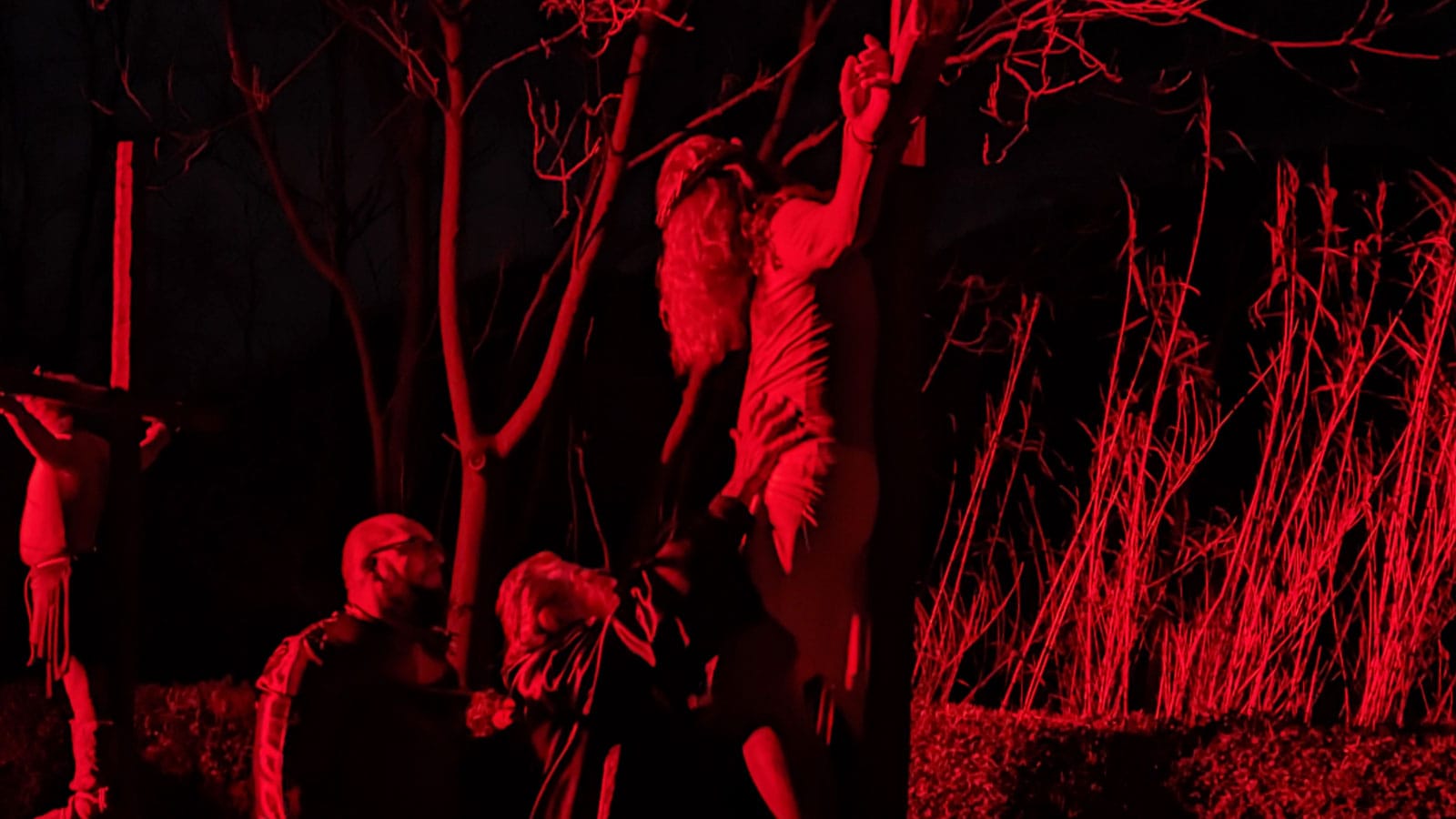
The Crucifixion, with the crosses raised in the night and the figures gathered at the foot of the scaffold, immersed in red light.
Photo by Emanuele Di Paolo,
Ornano Grande, Colledara (TE), 29 March 2026,
Don Nicola Jobbi/Bambun Study Centre Archive.
Photo by Emanuele Di Paolo,
Ornano Grande, Colledara (TE), 29 March 2026,
Don Nicola Jobbi/Bambun Study Centre Archive.
From Death to Life
The empty tomb
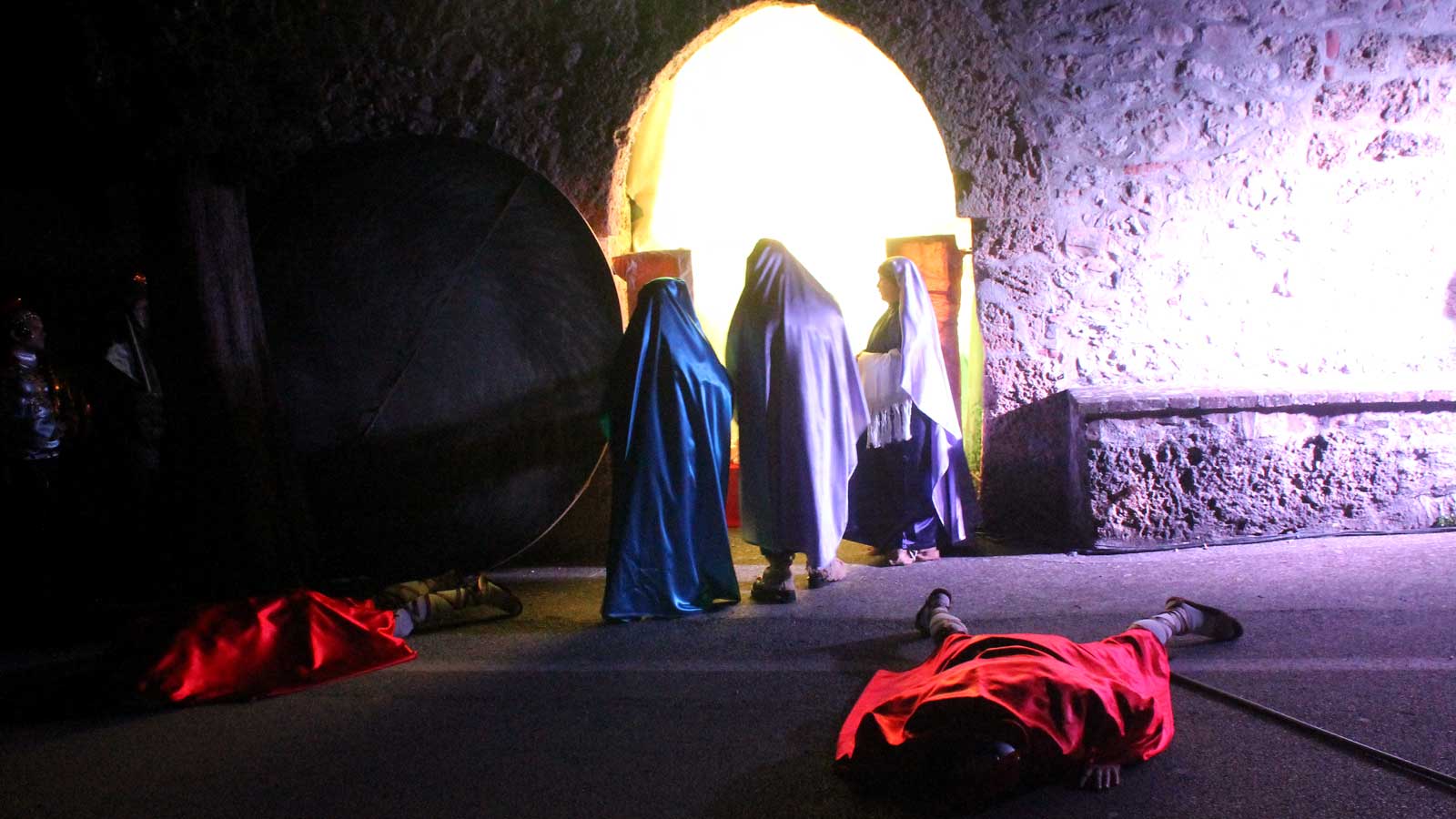
The Resurrection: the large round stone has been moved aside; the women arrive before the open and illuminated tomb while the guards lie on the ground.
Photo by Emanuele Di Paolo,
Ornano Grande, Colledara (TE), 29 March 2026,
Don Nicola Jobbi/Bambun Study Centre Archive.
Photo by Emanuele Di Paolo,
Ornano Grande, Colledara (TE), 29 March 2026,
Don Nicola Jobbi/Bambun Study Centre Archive.
Watch the video
The condemnation
A scene from the Passion of Christ: Jesus, after the scourging, escorted by Roman soldiers and wearing the crown of thorns, is condemned to crucifixion.
Ornano Grande, Colledara (TE), 29 March 2026.
Footage by Emanuele Di Paolo,
Don Nicola Jobbi/Bambun Study Centre Archive.
Ornano Grande, Colledara (TE), 29 March 2026.
Footage by Emanuele Di Paolo,
Don Nicola Jobbi/Bambun Study Centre Archive.
Cultural transmission and protection
The Passion of Christ in Ornano Grande is a modern sacred representation. Originating in the mid-2000s through a local initiative as a community experience of popular theatre, it nevertheless expresses a distinctive continuity — although articulated through a different expressive form — with a centuries-old Easter tradition of Ornano that had been abandoned only a few years earlier: the Good Friday procession, in which a series of performers, especially women, embodied through singing the sorrow for the death of Jesus in the procession dedicated to the Dead Christ. The contemporary living representation centred on the Passion can therefore be understood as an updated reformulation of a religious feeling that the village had already experienced and sustained over a long period; in Villa Petto, another hamlet within the municipality of Colledara, the Good Friday procession instead continues, despite increasing organisational difficulties, according to the forms handed down by the complex paraliturgical apparatus, guided by the parish priest but effectively governed by local specialists engaged in transmitting repertoires and roles.
The continuity of the Ornano representation remains fragile, as demonstrated by the five-year interruption that began with the COVID pandemic in 2020 and was ultimately overcome with the revival of 2025 thanks to the commitment of the Passio Cristi committee, the Pro Loco of Ornano, the parish and numerous volunteers. The survival of these representations depends, in fact, on the renewal of performers, on the availability of those who sew costumes and prepare stage settings, on the financial resources available from time to time, and on the ability to keep alive the community involvement upon which they are founded.
In terms of recognition, the sacred representations of Holy Week are currently involved in a safeguarding process promoted by Europassione per l’Italia, which, within a European framework, pursues their candidature for inscription on UNESCO’s Representative List of the Intangible Cultural Heritage of Humanity. In Abruzzo, among the participating examples is the Sacred Representation of the Passion of Atessa, included in the international Europassion network for the development and safeguarding of Holy Week rites and their related tangible and intangible cultural heritage. The Passion of Ornano Grande — a younger tradition rooted at village scale — shares with these experiences the character of living intangible heritage founded upon community participation, as has also happened in recent years in nearby localities through similar initiatives, including that of Val Vomano in Penna Sant'Andrea, promoted by the parish and the local Pro Loco.
The continuity of the Ornano representation remains fragile, as demonstrated by the five-year interruption that began with the COVID pandemic in 2020 and was ultimately overcome with the revival of 2025 thanks to the commitment of the Passio Cristi committee, the Pro Loco of Ornano, the parish and numerous volunteers. The survival of these representations depends, in fact, on the renewal of performers, on the availability of those who sew costumes and prepare stage settings, on the financial resources available from time to time, and on the ability to keep alive the community involvement upon which they are founded.
In terms of recognition, the sacred representations of Holy Week are currently involved in a safeguarding process promoted by Europassione per l’Italia, which, within a European framework, pursues their candidature for inscription on UNESCO’s Representative List of the Intangible Cultural Heritage of Humanity. In Abruzzo, among the participating examples is the Sacred Representation of the Passion of Atessa, included in the international Europassion network for the development and safeguarding of Holy Week rites and their related tangible and intangible cultural heritage. The Passion of Ornano Grande — a younger tradition rooted at village scale — shares with these experiences the character of living intangible heritage founded upon community participation, as has also happened in recent years in nearby localities through similar initiatives, including that of Val Vomano in Penna Sant'Andrea, promoted by the parish and the local Pro Loco.
OTHER ASSETS IN THE SAME MUNICIPALITOTHER ASSETS IN THE SAME MUNICIPALITY

Voices of Passion
Good Friday at Villa Petto

“Golden” meat
Preparing Porchetta in Colledara

The shoots of the mammara
Gathering wild asparagus in Villa Petto

From the garden to the flame
Preparing roasted peppers in Ornano